
During last week's Nuclear Security Summit, President Obama asked the media to leave and then screened videos depicting plausible scenarios pertaining to nuclear terrorism.

President Biden underscored that the United States will 'continue to stand up for its interests and values and, together with our allies and partners, ensure the rules of the road for the 21st century advance an international system that is free, open, and fair', the White House said in a readout of the meeting.

Reagan, who denounced the then USSR as the 'evil empire', was won over by the charm of the Soviet Union's final leader, Mikhail Sergeyevich Gorbachev.

Biden made the remarks after an 'emergency meeting' convened by Biden of North-Atlantic Treaty Organisation (NATO) and G7 leaders on the sidelines of the G20 Summit in Bali, Indonesia.

India scripted history as the ambitious third Moon mission of the Indian Space Research Organisation (ISRO) touched down on the Moon's south pole, propelling the country to an exclusive club of four and making it the first nation to land on the uncharted surface.

Price said India's relationship with Russia developed over several decades.

At a meeting with Yoshihide Suga on the sidelines of the Group of Seven summit in the British seaside resort of Carbis Bay, US President Joe Biden also raised a range of other issues including COVID-19, North Korea, China and climate change, the White House said in a statement.
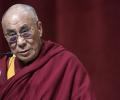
US Special Coordinator for Tibetan issues Uzra Zeya will travel to India and Nepal this week to deepen cooperation on human rights and democratic governance goals with the two nations, the state department has announced.

Obama and Modi would primarily focus on climate change but will also review progress in bilateral relationship and discussion on regional and global issues including terrorism.
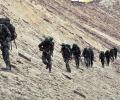
The report said that Indian officials believe China is trying to contain India by forcing it to divert more resources into defending simultaneously both its western border with Pakistan and eastern flank with China and by weakening its willingness and ability to challenge Chinese ambitions to dominate the region.

R Sai Kishore came up with a splendid all-round show as South Zone trumped North Zone by two wickets in a thrilling finish in the rain-hit semi-final.

'All this talk of 'tactical nuclear weapons' or a limited nuclear war are 'false flags'! It looks like India and Pakistan are slowly but surely inching towards this realism,' says Colonel Anil A Athale (retd).
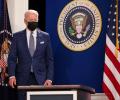
The Quad partnership is on track to produce at least a billion vaccine doses in India by 2022, US President Joe Biden said on Wednesday, asserting that nothing is more urgent than working together to defeat COVID-19 so the world is much better prepared for future pandemics.

Modi also gifted Harris a 'gulabi meenakari' chess set, the sources said, adding that the craft of 'gulabi meenakari' is closely associated with Varanasi, one of the oldest cities of the world and the prime minister's Lok Sabha constituency.
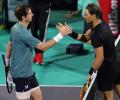
Former world number one Andy Murray eased past Rafael Nadal in the Spaniard's comeback match at the World Tennis Championship exhibition tournament in Abu Dhabi on Friday.

The Modi government has been put on notice.'Will it buckle under such pressure? These are times when the moral fibre of the leadership makes all the difference, observes Ambassador M K Bhadrakumar.

Modi will address world leaders from the iconic United Nations General Assembly hall on the morning of September 25, a day after he participates in the Quad Leaders' Summit in Washington, DC hosted by Biden on September 24.
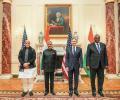
The pressure on India to take a hostile attitude towards Russia and China was not subtle, but it was guarded, observes Ambassador T P Sreenivasan after Monday's 2+2 ministerial meeting in Washington, DC.
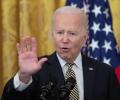
Biden, while not ruling out the meeting Putin at G20 meet, said that there are conditions attached.
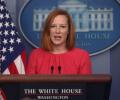
"AUKUS? What would it become? JAUKUS? JAIAUKUS?" Psaki said in lighter moments before giving answer to the question.
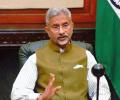
External Affairs Minister S Jaishankar will arrive in New York on Sunday to participate in the high-level 77th session of the UN General Assembly, which kicks off on September 20 with the opening of the general debate.
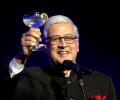
'I think my first obsessive, possessive and only half-requited -- as we would joke -- 'love' was Ivan. I saw him first slouching down the corridor of St Stephen's College nearly 50 years ago and was instantly smitten (as was everyone else around him).'

Pakistan is once again becoming a frontline State in big-power rivalry. But this time around, Pakistan stands to gain out of its geography, observes Ambassador M K Bhadrakumar.
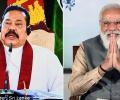
Mahinda Rajapaksa is a democratically elected leader who received a massive mandate of 71% of votes, and he owes nothing to Delhi or Washington for staging his political comeback, observes Ambassador M K Bhadrakumar.

United States Secretary of State Antony Blinken during his maiden trip to India next week would meet Prime Minister Narendra Modi and External Affairs Minister S Jaishankar to discuss wide range of bilateral, regional and global issues, his spokesperson said on Friday.

Beijing will be intently watching Washington's response for any hint of weakness. Xi Jinping, who feels China has a limited window of strategic opportunity, will be emboldened to take additional initiatives in the Indo-Pacific and specifically against India and Taiwan, warns Jayadeva Ranade, the former senior RA&W officer and China expert.
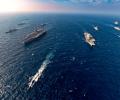
Remarks from Indian External Affairs are significant as it comes after China slammed Quad and said the formation of "exclusive cliques" targeting other countries runs counter to the trend of the times and is "doomed to fail".

The letter comes as the two sides negotiate details of a second meeting between the two leaders. It was flown to Pyongyang and delivered by hand, the CNN reported, quoting a source familiar with the ongoing talks between Washington and Pyongyang on denuclearisation of the Korean Peninsula.

Blinken will also attend a meeting of the foreign ministers of the Quad grouping and will hold bilateral talks with his Indian counterpart S Jaishankar in Delhi.

Kim Jong-un declared he would never surrender North Korea's nuclear weapons weapons even if his country faced 100 years of sanctions. Dr Rajaram Panda explains Pyongyang's new nuclear doctrine that makes the world a much more dangerous place.
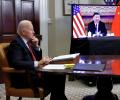
The highly-anticipated summit, which began early Tuesday, is the third engagement between Xi, 68, and Biden, 78, since February.

'From what evidence has come up, General Bajwa somehow managed to tell the Americans that I was anti-American.' 'And so, it [the plan to oust me] wasn't imported from there. It was exported from here to there.'

Known to be having extensive expertise in dealing with India's neighbourhood as well as the US, China and Europe, the 1988-batch Indian Foreign Service (IFS) officer pipped nearly half-a-dozen others in the race for the coveted post including Indian High Commissioner to UK Gaitri Issar Kumar (1986-batch IFS) and Ruchira Kamboj (1987 batch IFS).
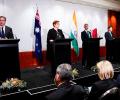
India is a driving force of the Quad and an engine for regional growth, said the White House, days after foreign ministers of the countries, which are part of the grouping, met in Melbourne.

India shifted gears in rejuvenating strategic ties with its major partners like the US and Russia and focused on drumming up global support for its distinct strategy in the Indo-Pacific to check Beijing's increasing muscle-flexing in the region.

Modi will embark on a three-nation tour beginning March 30 during which he will attend the crucial Nuclear Security Summit in Washington, India-EU Summit in Brussels and travel to Saudi Arabia, a key partner of India in the sensitive Gulf region.

India and the US are the world's largest democracies and the two countries are committed to taking on the toughest challenges together, President Joe Biden said after his first-ever in-person meeting with Prime Minister Narendra Modi at the White House.

Describing the meeting as "a very good one", Foreign Secretary Shyam Saran told reporters that basically what 'she (Rice) did was to set the stage for the important meeting between President Bush and the prime minister'

Musharraf, 79, was suffering from amyloidosis, a rare disease caused by a build-up of an abnormal protein called amyloid in organs and tissues throughout the body, The Express Tribune reported.
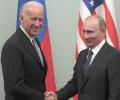
Earlier this month, the White House said that US President Joe Biden believed that his meeting with his Russian counterpart Vladimir Putin will be a good step forward in the US-Russia relationship to de-escalate tensions and have stable relations.
